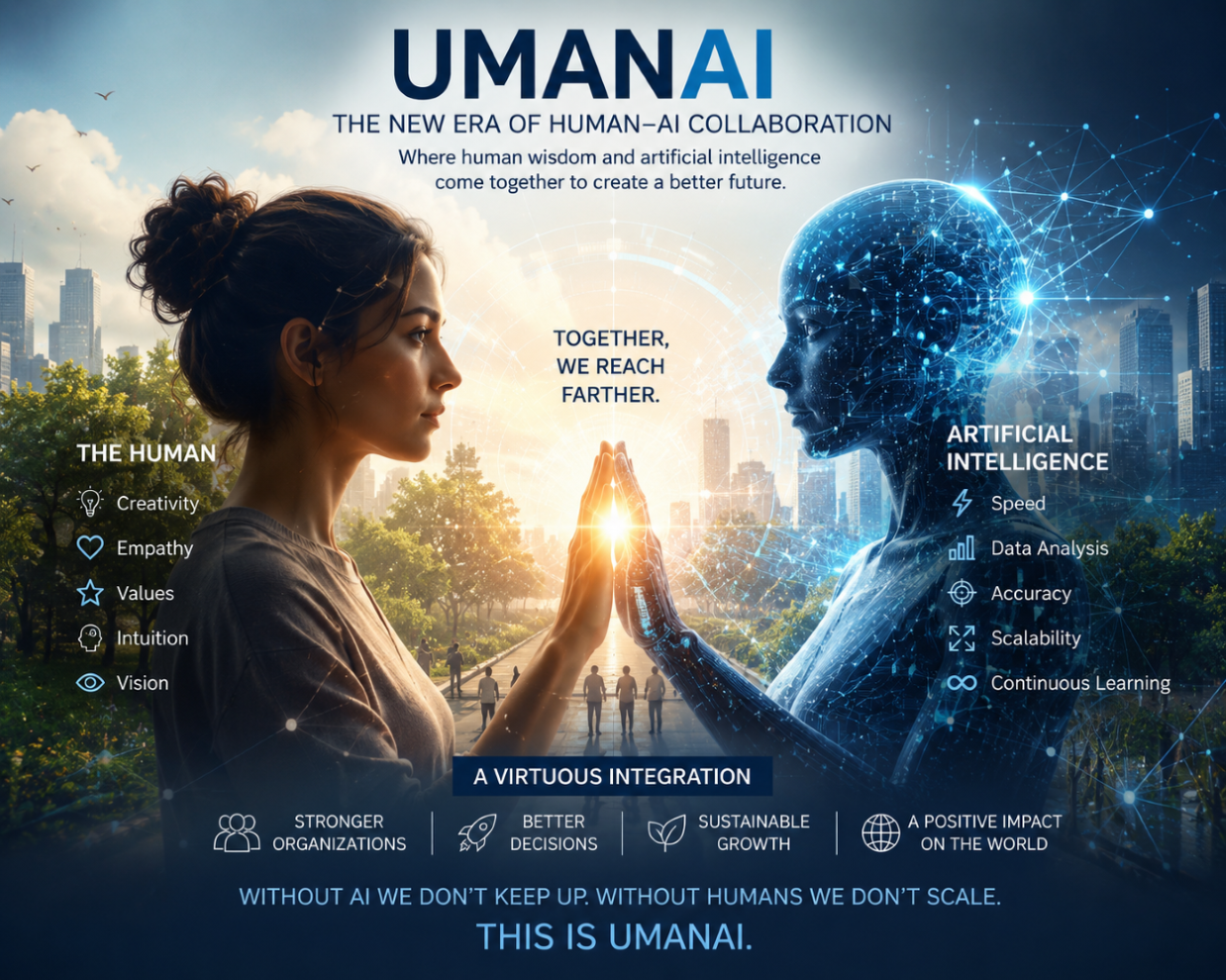

Over the past months, artificial intelligence has been discussed extensively in relation to organizations and the future of work.
Most of the conversation has focused on tools, automation, productivity, and speed.
But during the Future Week event in Turin on May 25th, a much deeper issue clearly emerged:
the real transformation is not only about technology.
It is about the idea of humanity we choose to build within this new era.
For example, through the contributions shared by the De Bono Academy, it became evident how AI is already reshaping business processes, organizational design, and even the way we analyze complex problems.
This perspective strongly resonates with the work of Eric Topol in AI-augmented medicine: AI not as a replacement for doctors, but as an enhancement of human capabilities through intelligent systems able to free time, increase precision, and strengthen human relationships.
Today, thanks to vertical AI tools and intelligent systems, we can:
- structure projects more organically;
- accelerate information processing;
- deepen analytical capabilities;
- improve decision-making quality.
And yet, all of this alone is not enough.
Because the real question is not:
“How powerful will artificial intelligence become?”
The real question is:
“How evolved will we become in the way we integrate it?”
Two passages from Pope Leo XIV’s new Encyclical help us enter the heart of this reflection.
The first states:
“If technological development proceeds without adequate ethical and social maturation, we may end up increasing our means without increasing our humanity: we may ‘have more’ without truly ‘being more’, and the human person risks being evaluated mainly according to performance.”
The second highlights a decisive principle:
“For AI to truly respect human dignity and serve the common good, responsibilities must remain clear throughout every stage — from those who design and train systems to those who use them and delegate concrete decisions to them. Accountability becomes essential.”
The Pope’s message is extremely clear:
without transparent goals and a human-centered strategy, AI can become dangerous.
But when guided by ethical vision and designed to enhance people rather than replace them, AI becomes an extraordinary opportunity.
Organizations therefore need an integrated, structured, and conceptually solid framework capable of balancing technology, culture, and human development within their specific context.
This is exactly where the NIO project — Nuova Intelligenza Organizzativa (New Organizational Intelligence) — comes into play.
For years I have argued that organizational transformation cannot be interpreted merely as technological innovation.
What we truly need is a new relational, cultural, and cognitive architecture able to integrate:
- AI,
- generative leadership,
- continuous learning,
- people engagement,
- collective intelligence.
This is why I believe we are entering a completely new era.
The UMANAI Era.
A new age in which a human neo-Renaissance merges with artificial intelligence to create an augmented humanism capable of leading women and men toward higher levels of awareness, creativity, responsibility, and evolutionary potential.
Ultimately, the point is not to choose between humans and machines.
The point is to understand what form of co-evolution we will be able to build together.
For a long time, I have summarized this concept through a very simple sentence:
“Without AI, organizations will not hold.
Without humans, they will not scale.”
And perhaps someone today could add:
“Without humans, they will not even sell.”
Because people still seek meaning, trust, empathy, recognition, and vision.
AI can multiply operational possibilities.
But meaning must remain profoundly human.
One of the most interesting insights emerging from the Turin discussion concerns precisely the psychological relationship between people and AI inside organizations.
Many fear artificial intelligence because they interpret it as replacement.
In reality, it could become the exact opposite:
an extraordinary opportunity for cognitive emancipation and liberation from repetitive and alienating tasks.
AI provides us with answers.
Countless answers.
Even about hidden details and invisible patterns inside decision-making processes.
But precisely because of this, human beings may finally return to focusing on questions.
Authentic questions.
Questions capable of generating meaning.
Questions that open new interpretative possibilities.
In this sense, I find Gianni Vattimo’s hermeneutics of emancipation profoundly relevant today:
learning to inhabit our own questions as spaces of liberation.
Perhaps the real danger is not that machines will learn to think like humans.
The real danger is that humans may stop questioning themselves.
And this is why the new organizational form will not simply be “technological.”
It will be integrated.
A synthesis between:
- formative structures,
- formed structures,
- personal identity,
- artificial intelligence,
- human experience,
- augmented knowledge.
This is how UMANAI will truly grow.
Not as the domination of machines over humanity.
But as a new evolutionary alliance.
Just as in advanced medicine, the future of organizations will not depend only on the quality of intelligent tools, but on the ability of people to use them with responsibility, serenity, vision, and relational maturity.
The true revolution will not be having more AI.
The true revolution will be building more human organizations capable of using advanced artificial intelligence to achieve extraordinary forms of synthesis — while protecting dignity, meaning, and collective well-being.