

On the stage, Joan Mulvihill, artist and tech evangelist
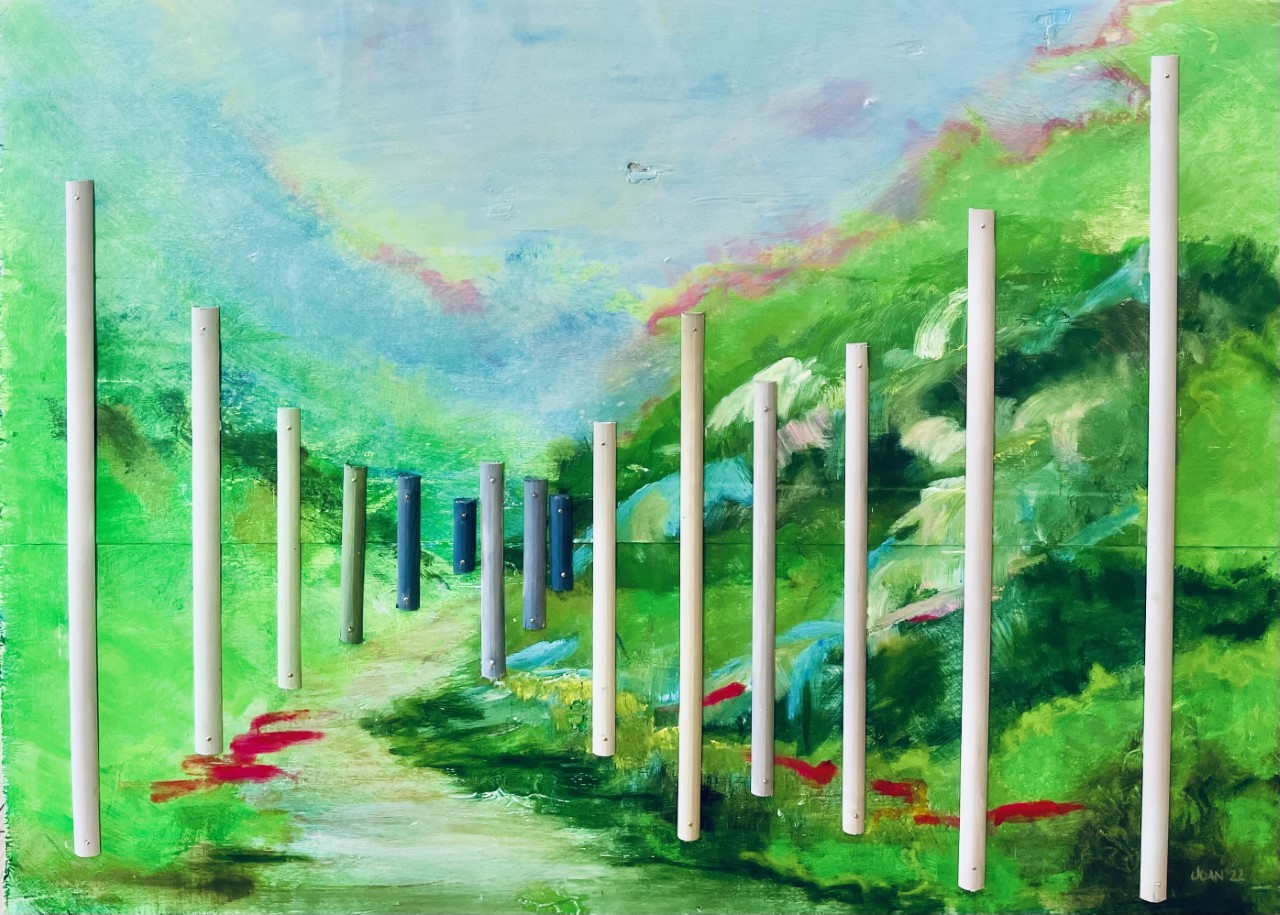
Work by artist Joan Mulvihill
In Ireland, the unique intersection of art and technology is not just a coexistence but a merging. It is a country deeply rooted in a cultural reality that boasts a vast population of literate and artistic individuals. It’s a culture that’s not just a romantic idea but one deeply rooted in history and actively supported in contemporary society. With a significant number of world-leading technology companies (16 of the top 20 global technology companies have a presence, notably in Dublin at the ‘Silicon Docks’), the thriving literary and artistic community has been joined by a new community of technologists engaged in artificial intelligence, data science, cloud engineering and cybersecurity.
What unites humanists and technologists in Ireland is a shared goal of cultivating the logos of techne. This is the study of art and the practical ability (defined by the philosophy of ancient Greece as techne) of making things. It’s a collaborative effort that’s shaping the cultural landscape of Ireland.
The Irish government is not just a passive observer, but an active supporter of the golden embrace between all these cultural actors. They are fostering initiatives that experiment with digital tools to create immersive experiences, interactive installations, digital art, and new forms of storytelling. The Creative Ireland Programme has launched the “Digital Creative Industries Roadmap 2024-2026”, a testament to the government’s commitment to this intersection. The AURA network (UK-Ireland Digital Humanities Network) is integrating artificial intelligence into cultural heritage projects, making digital archives more accessible and usable. This support is a reason for optimism about the future of art and technology in Ireland.
One impactful example of the golden embrace is Joan Mulvihill, a contemporary landscape painter who abstracts form and colour from the trees, farms and marshes of Ireland. But she is not just an artist. She is also a senior business leader in the technology sector with extensive corporate experience in various industries: ICT, retail, manufacturing, professional services and non-profit. Her diverse background is a testament to the potential for cross-disciplinary collaboration in the intersection of art and technology.
Below, we report her thoughts on Ireland, “a small island country in the digital age”.
“Where wealth accumulates and men decay”, The Deserted Village, Oliver Goldsmith, 1770. It is safe to say no one is accumulating more wealth and with souls decaying faster than the men in big tech.
I am on a mission to rehumanise organisations. I want to see robust and resilient organisations that are less about being data-driven and more about being human-led. I believe that we will never reap the true benefits of digitalisation until we first understand our role as the human leaders of this natural world.
I see this digital age as one of opportunity, discovery and innovation. Technology makes almost anything possible and yet, for so many the future seems so bleak. At a time when the technology can unlock the answers to so many of our questions, perhaps our challenge lies in asking the right questions.
For the most part, large organisations have been designed to recognise, reward and promote the humans that behave like the best machines – consistent and reliable, focused and tireless, while building machines to behave like humans. Is it such a radical concept for us to try behaving like good humans and let the machines behave like good machines.
But what would it even mean to be good human? It seems to me it comes down to two things: Creativity and Purpose.
We are the only species that can imagine something that does not yet exist and create it. We alone can bring an idea to life.
And Purpose – We are the only species that understands the concept of our time on this earth. We know that we have ancestors and descendants and we find meaning in legacy and stewardship. It is this meaning that gives our lives purpose, we need it. Utopia is not having nothing to do. Utopia is finding your purpose and doing what you love to do.
The greatest expression of our humanity is where our creativity meets our purpose. And herein lies the challenge for organisations – creative purpose driven people are notoriously difficult to manage!! Organisations have not been designed to scale with humans behaving like such wild humans!!
We are unruly and outspoken. We are intolerant and idealistic. Creative purpose driven people, good humans are burdened with honouring the legacy of those who have gone
before and feel accountable to those who come after. Good humans are driven to create a better world.
So here we are, a small island country in a digital age at the epicentre of building the infrastructure that bridges how we live in this physical world empowered by the technology of the virtual world.
And we’ve done it before. Not far from here. 4000 years ago. We built an infrastructure that linked the physical world to the “other” world, the spirit world.
We are not far from Uisneach, the very centre of Ireland. During the Neolithic Age, 4000 years ago, the hill at Uisneach was our ceremonial, administrative and spiritual centre. It is here that the limestone rock, “The Stone of the Divisions” marks where the then five provinces of Ireland meet; Leinster, Munster, Connacht, Ulster and Meath. From the top of the hill, you can see up to 22 counties. Fires were lit from there to communicate with other communities, fires that could be seen from Lough Crew, Tara, Cong, Rathcroghan, Cashel. As time passed, power shifted. Tara became the seat of royal power of the physical world but Uisneach remained the sacred spiritual centre and our connection to the other world.
This Neolithic infrastructure emanating from Uisneach persists. It is understood through the archaeological artefacts of an ancient infrastructure of souterrains, stone circles and bog trackways, and the found treasures of brooches and cups. It is remembered and retold in oral and transcribed stories. There was creativity and purpose in building it and there is continued purpose in preserving it, in being stewards of it as a sacred space. No. We are not new to building enduring infrastructure.
Millenia later and just a little further west of here there is another site, less romantic and sacred but epic nonetheless. The hydro-electric power station at Ardnacrusha is 100 years old this year so it has earned its place in today’s story.
As a feat of (Siemens) engineering, it was the world’s biggest dam in 1925. Ardnacrusha is testament to our humanity. The power of the Shannon was not harnessed by engineering and physics alone but by creative people of purpose. Some people across the water said ‘those (Irish) poets and dreamers will never make it happen’ but they are people who underestimated the power of the artist-leader. The poets and the dreamers are at the heart of every great change, every great revolution. It was just a few years before that Arthur Griffith from his prison cell wrote “It’s time to unleash the poets”.
It takes great engineering to make things happen, but it takes great heart to want to.
This infrastructure still stands. And while it stands as a feat of engineering, just as it is with Uisneach, it is what it stands FOR that matters more: both are historical reference points in our country’s story, our culture, beliefs and values of those times.
Building infrastructure is not about what we build now. It is about the future. It is about imagining the world as we would want it to be and breathing life into it.
And just as Uisneach and Ardnacrusha are in conversation with the physical environment of hills, fires and rivers, our infrastructure for this digital age does not exist in isolation either. It seems to me that infrastructure that endures works with and for the natural world and all of its inhabitants.
Stone Age, Iron Age, Industrial Age, Digital Age. These are just passages in time. This is the digital age of this natural world and we as humans have the responsibility to lead it. And we need to lead better. I am all for data driven decisions but more importantly, I believe in human-led organisations. This cannot become an age of DATA Imperialism where we abdicate leadership to “the data made me do it”.
Being human-led recognises our role in stewardship. In this now digital age, we are not carving rings on rocks at Newgrange anymore or transcribing stories to books for preservation in the Trinity Library. All of our created content is with these technology companies, companies controlled by these soul decaying men. Held in their data centres, moving through their ether – our music, our books, our poetry, our diaries, our lives.
One hundred years from now what will be in the libraries and museums of the Digital Age? Three thousand years from now, what will some future civilisation discover of us? What archaeological artefacts will remain that will give them insight into who we are, how our society worked, what was important to us, our values and our beliefs?
I said that AI has the power answer to anything. There is no problem bound by the laws of science, engineering, technology, mathematics that it cannot solve. But what of problems unbound by such immutable laws but simply constrained by the artificial constructs of rules and regulations? Who made them? Do they still hold true? In their absence, where the policies of the talking men have been outpaced by the technology of decaying men, we need to reconnect with our own moral compass. Where is it pointing?
In Chinese mythology there exists 172 unanswerable questions to the Gods, known as the Heavenly Questions. The Chinese artist and activist Ai Wei Wei, mirrored these with 81 unanswerable questions to ask of AI, one question for each day of his political imprisonment. These unanswerable questions include ‘which lasts longer, love or hate?’ and ‘who am I?’
These are questions for humans not machines. These are questions for leaders. Who are we and what is important to us? As humans leading, we must do better.